





About Us

Who we are

We are the School of Philosophy South East London, a branch of the School of Philosophy and Economic Science, with Head Offices in London. Further information on the School as a whole is through the website www.schoolofphilosophy.org.

Both the parent school and its branches are run as an independent educational charity.


Our centre

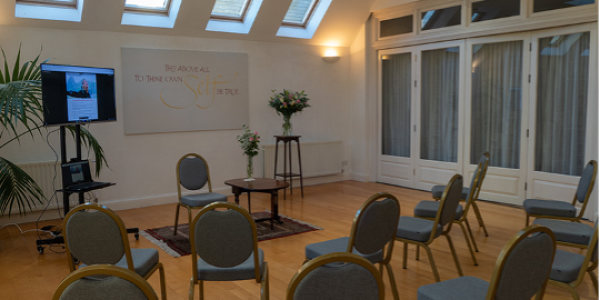
Our centre is at Athene House, 13 Addiscombe Grove, Croydon CR0 5LR. Tutors are all senior students of the School and offer their time for free; the fees we charge are solely to cover the costs of the building and administration.

Existing students who temporarily cannot attend their regular groups are offered a temporary hybrid solution (a Zoom link by arrangement with their tutor) whereby they can attend their groups remotely and not miss any sessions during the term.

Discussion groups

The School works through discussion in groups.

All tutors are also students of philosophy within the school, and attend weekly classes as a student.

The intent of the school is that everyone attending, however long or short their stay, will find something of value for use in their lives.

All are welcome

All are welcome to sample what the school has to offer through the introductory course, and to continue further with their studies as they wish.

We are an educational charity and a not-for-profit organisation. Course fees are kept as low as possible and are used to enable the school to continue to offer its courses to as many people as possible.

How it works

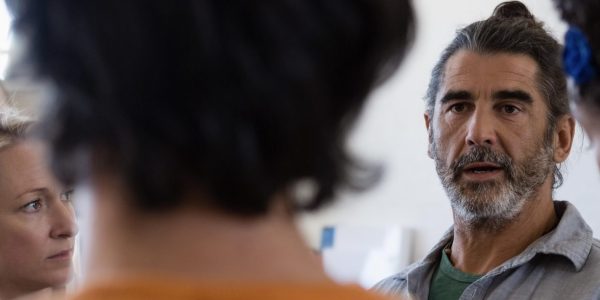
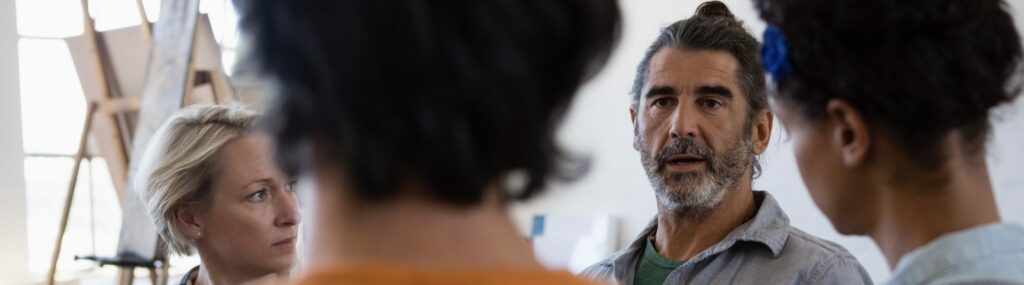
A tutor presents material, and leads a discussion based on what arises. Being practical rather than academic, the emphasis is on personal knowledge. Students are encouraged neither to accept nor reject the ideas put forward, but to test them in practice for themselves, in the light of their own experience.

Frequently asked questions about our courses

The course is practical in the sense that it is designed to be of direct use in our everyday lives. The intention is to stimulate enquiry and through this expand the way we look at the world and ourselves.

Online or by calling 0208 688 2634.

If you register online, you will receive a confirmation email with your day of attendance. If you register by any means other than online, you will receive a receipt confirming your registration.

Yes, we have a local Croydon venue where you can attend the course face-to-face. We also have other venues across the UK.

No, all you need is an open and enquiring mind. The course is intended for everyone, regardless of education, occupation, race, political or religious belief.

Face-to-face meetings will be held safely following all Health & Safety guidelines for your complete peace of mind.

Yes, we offer an online version of the course via Zoom. To find out more visit: https://courses.schoolofphilosophy.org

What some of our students say...

Local Course

Local face-to-face evening courses available at a choice of locations.

Practical Wisdom

Courses in practical wisdom for everyday living. Meet with like minded individuals.

“Absolutely loving the course!! …Really changing how I think about things and life in general.”
“...I am benefiting greatly from the content and the practical nature of it. Thank you, it is enriching my life.”

Choose your preferred course below...

What’s covered in the 10-week course (click below):

Themes included in the course

These opening sessions consider how philosophy can help us enjoy richer, less stressful lives.

What is practical philosophy?

‘What would a wise person do here?’

Philosophy means the love of wisdom. Our course is intended to show how philosophy can help us enjoy richer, less stressful and more useful lives. This opening two sessions consider these aims, and introduces simple exercises in mindfulness and the application of wisdom you can practise in daily life.

You can download or listen to the Awareness Exercise, introduced in week one here. To download, right-click, choose ‘Save link as…’ and save the MP3 wherever you want.

You can also download a PDF of the Awareness Exercise

Who or what am I?

What is my potential?

Who am I, really? My body? My emotions? My strongly held beliefs? My soul? Possibly all of these? Possibly none?

Such questions have preoccupied philosophers down the ages. We look at practical ways to explore who we really are and how to tap our true potential.

What is our state of awareness?

Why does it fluctuate during the day?

Often the most notable quality of wise people is their alertness to the subtleties of a situation. They are awake, perceptive and curious.

We look at deeper levels of awareness, and consider how we may become more awake to ourselves, our surroundings, and the events we meet.

Living in the now, mindfulness.

What is the potential of the present moment?

We review our own experience of attention through a model featuring attention centred, captured, open and scattered, and how these each relate to the past, present and future.

We examine the extraordinary brightness and freedom naturally available in the present moment. A straightforward practice is introduced.


Plato’s views on justice.

What does it mean to live justly?

According to Plato, justice and injustice do not start ‘out there’. They begin within us. For justice to prevail, Plato suggests that we must learn to avoid being ‘tyrannised’ by our passions and fears to the extent they overrule our reason.

We discuss the practicality of Plato’s ideas on justice in our daily lives.

The Vedic model of three fundamental energies.

Sometimes we seem not to have enough energy, or the wrong kind. A wise person can act consistently despite these varying conditions.

We consider how to recognise differing energies, how to gain and conserve them and how to use them wisely.

What is reason? How can it enrich our lives? We look at guidelines for Socratic dialogue and how to use them. Developing reason in decision-making and action are also discussed, with practical applications. Obstacles to reason are considered. Everyone has the faculty of reason and we can all use it and develop it. 

What is beauty?

Is there such a thing as absolute beauty?

Beauty has the capacity to open the heart and bring delight. In this session we discuss our direct experience of beauty in its different form: of the sensory world, of thought, of feelings, of the inner nature, and of conduct.

We consider Plato’s idea of there being ultimately one beauty – beauty absolute – ‘not knowing birth or death, growth or decay’.


Looking for the common thread in life.

What is the effect of finding unity?

When we look around, we see enormous diversity in nature. The wise person looks for the unifying factor: that which allows all this apparent diversity to be seen as part of a single whole.

Seen in this way, life then has the best chance of being led freshly and openly.


What is truth?

How does the desire for truth show itself?

Practical philosophy is about discovering the truth of things – not theoretically, but in our own experience.

In this final session we look back and ask ourselves how our search for truth has fared as the term has progressed. We discuss what has been discovered and how, in our own way, we may continue to develop it in our daily lives.

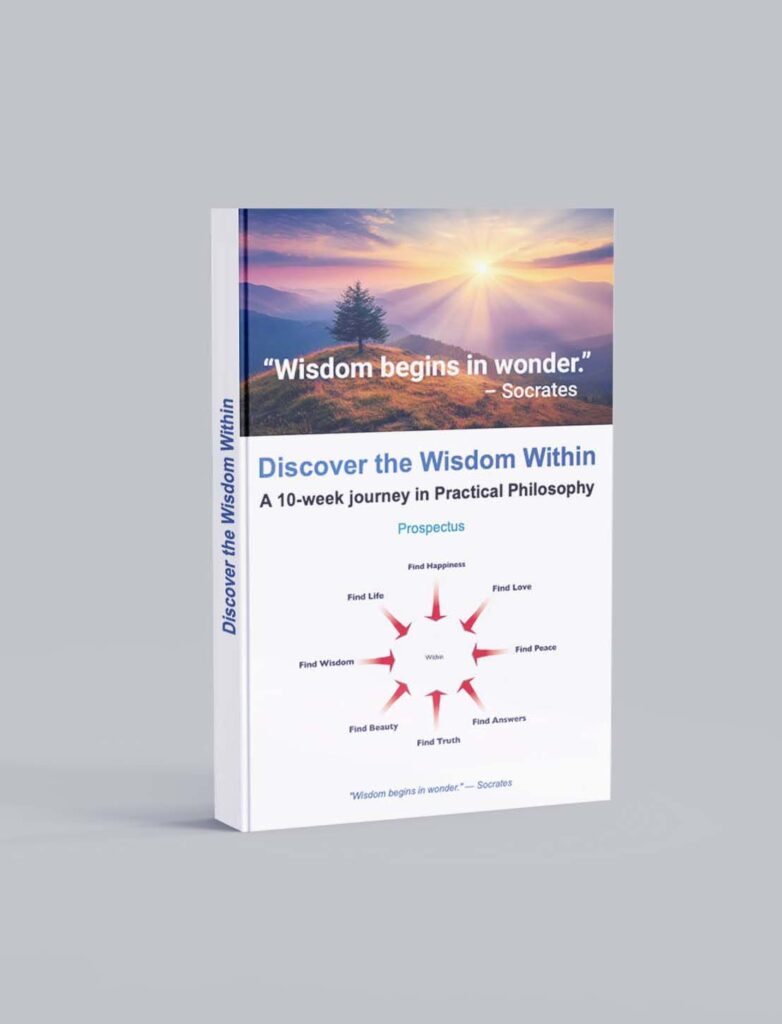
FREE Course Prospectus: A breakdown of our 10 week courses

Download our Free Prospectus and get 12 transformational quotes also. Just let us know where to send it to below…

TRANSFORMATIONAL

Many of our students tell us how life transformational our courses are.

So as a way of giving back and making our transformational ‘Introductory 10-week course’ affordable for as many people as possible, we are allowing you to enrol for this ‘FULL 10-week Introductory Course’ for…

…only £35, nothing more to pay!

(The equivalent of £3.50 per week).

Please note: This offer gives you a risk-free opportunity to experience our transformational courses first-hand. NOTE: Due to this low introductory pricing these introductory courses do tend to get fully enrolled in advance.

0